Competition Information
Sac Town Hoedown 2026 will be hosting line dance and country swing competitions on Saturday 9/26. Our competitions will be apart of the National Country Dance Circuits system, meaning that you can now compete to earn points towards your national ranking! Scroll for detailed information on both types of competitions.
Buy Your Comp Tickets!
*All Competitors MUST PURCHASE a Weekend Pass in order to compete.

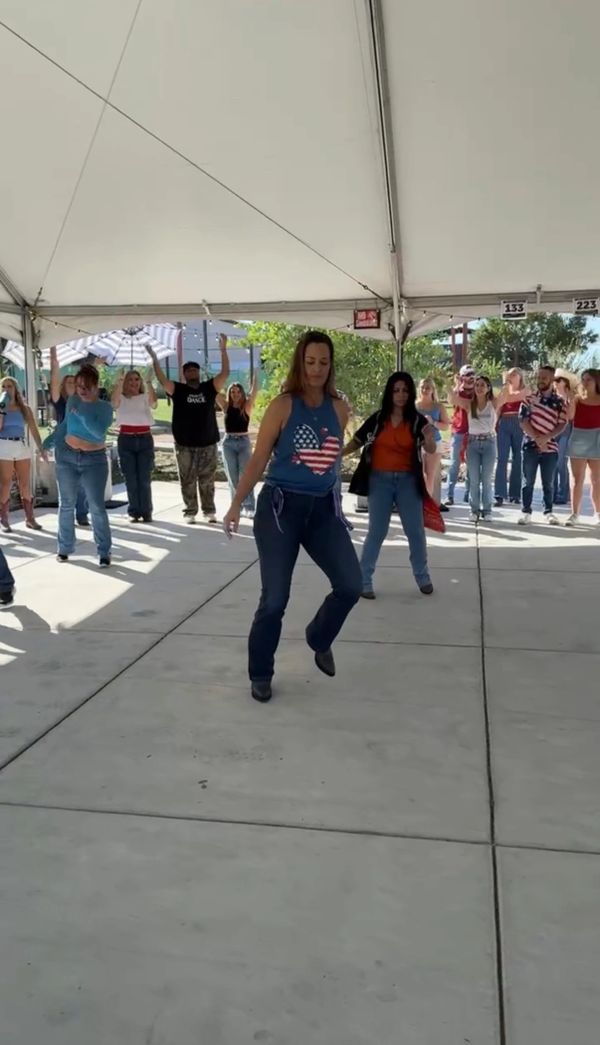


LINE DANCE COMPETITIONS
To compete at The Sac Town Hoedown you must:
- Be attending with a Weekend Pass.
- Register & pay competition entry fee. (Sign Up)
The line dance competition will be composed of multiple rounds during prelims & finals. There will be beginner/novice and intermediate level divisions. Competitors will be chosen by judges to advance to the next round for chances to win one-of-a-kind Sac Town Hoedown buckles, weekend passes to other events and more!!!
Competitions will begin on Saturday, September 26th after 3pm. You must compete in prelims to move on to semi-finals and finals. Competitions will be completed before Saturday night social dancing.
step sheets links
BEGINNER / NOVICE
step sheets links
INTERMEDIATE
Judging and Rules - Line Dance
Beginner
- The dancer has to think about steps & counts throughout the dance, some muscle memory is created with repetition and practice.
- The dancer is adding in limited variations. For example - adding a single rotation to a traveling step, or stomp to emphasize a beat.
- The dancer is focusing on adding natural arm movement to the dance.
- The dancer is focusing on having a pleasant facial expression during the dance.
Intermediate
- The dancer is able to create muscle memory of the dances steps & counts with repetition and practice.
- The dancer is beginning to explore the use of variations, adding in some step changes or extra rotations.
- The dancer has natural arm movement and is starting to add choreographed arm movement and styling to the dance.
- The dancer is beginning to explore the use of facial expressions in the dance.
Line Dance Rules
- 2 Full Vanilla Walls Required true to the stepsheet - Can be at any point throughout the dance
- Round Length
- Prelims - 90 Sec (2 Songs)
- Semi Finals - 90 Sec (1 Song)
- Finals - Full Songs (1 Song)
- Dancers must maintain proper spacing and distance throughout the entire dance.
- Staggered spacing is required and must be maintained to allow everyone the opportunity for "dance space".
- Variations must go with the flow of original dance choreography.
- No Aerials Allowed
- Aerial Definition - The dancer's feet may not leave the ground while the body is changing the plane of dance.
- No props
Line Dance Judging Criteria
All Categories Weighted Equally
- Timing - Line dance should be executed with proper stepsheet timing, variations must be on time with the music.
- Technique - Line dance should be executed with proper stepsheet technique, variations and stepsheet choreography should demonstrate good body mechanics, foot placements and articulation, arm engagement and facial expressions.
- Content - The styling and variations added to the stepsheet choreography.
- Showmanship - The overall performance of the dance.
Download THE LINE DANCE COMPETITION STEPSHEETS HERE
Beginner/Novice
COUNTRY SWING COMPETITIONS
To compete at The Sac Town Hoedown you must:
- Be attending with a Weekend Pass.
- Register & pay competition entry fee. (Sign Up)
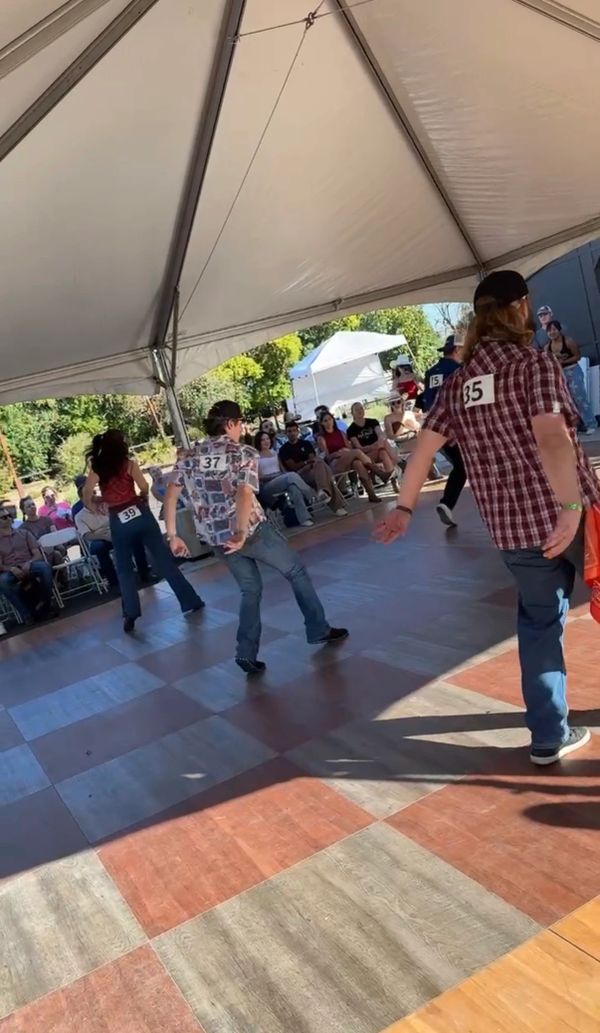
The partner dance competitions will be composed of two divisions, Strictly and Jack & Jill. Each division will have multiple rounds. Competitors will be chosen by judges to advance to the next round for chances to win one-of-a-kind Sac Town Hoedown buckles, weekend passes to other events and more!!!
Competitions will begin on Saturday, September 26th after 3pm. You must compete in prelims to move on to semi-finals and finals. Competitions will be completed before Saturday night social dancing
MORE DETAILS - COUNTRY SWING COMPS
Strictly
Description
- Dance with the partner of your choice. You are welcome to come with a partner or find someone at the event.
- LIFTS: Are allowed in Strictly as long as your partner is comfortable with it.
- Hitting others, dropping your partner, and not being mindful of others' space is grounds for disqualification.
- Stationary Freestyle: All stationary styles allowed - Country Swing, Bar Coast, West Coast Swing, etc...
Divisions
- All Level - Best of the best, there can only be one winner of the Sac Town Hoedown custom buckles!
Jack & Jill
Description
- Partners will be drawn at random.
- LIFTS: No lifts above the shoulders are allowed.
- Hitting others, dropping your partner, and not being mindful of others' space is grounds for • disqualification.
- Stationary Freestyle: All stationary styles allowed - Country Swing, Bar Coast, West Coast Swing, etc...
Divisions
- Beginner/Novice
- Intermediate
Country Swing Judging Criteria
All Categories Weighted Equally
- Timing - The dance should go to the rhythm set forth by the music, either SSS or QQS throughout their basic rotational patterns. Timing may be manipulated during the dance but it must accentuate the underlying rhythm of the song, and you should be returning to the same chosen base timing.
- Technique - The dance should demonstrate - country swing with a rotational basic. Slotted patterns should last no longer than 16-32 counts before returning to rotational The dance should also demonstrate good body mechanics, foot placements and articulation, arm engagement and facial expressions.
- Content - The styling and variations added into the dance, including facial expressions.
- Teamwork - The dance should demonstrate good communication between the partners in the dance through physical connection, spatial awareness, and eye contact.
- Showmanship - The overall performance of the dance.
DETAILED RULES- COUNTRY SWING COMPS
Country Swing Jack & Jill
Rules
- Dancer will enter under designated role - competing both designations lead & follow in the same level is not allowed.
- Round Length
- Prelims - 90 Sec
- Finals - Full Songs
*Full Song is defined as no longer than 2:30 - Dancers must maintain proper spacing and distance throughout the entire dance.
- The rotational integrity of country swing must be present.
Country Swing Strictly
Rules
- Dancers will enter as a designated partnership, Lead and Follow
- Prelims - 90 Sec
- Finals - Full Songs
*Full Song is defined as no longer than 2:30
- Dancers must maintain proper spacing and distance throughout the entire dance.
- Lifts Allowed - lifts must be done with proper safety and technique & dancers must be aware of their spacing when executing a lift. Beginner Level - lifts must remain below the waist
How to Structure Your Country Swing in
Each Round
Prelims: Show Me Your Foundation (50–60% basics & extended basics)
In prelims, I should be seeing at least half of your dance rooted in basics and extended basics—rotational patterns, 3–5 step patterns, and clean foundational movement. This is where I evaluate:
- Your posture
- Your footwork mechanics
- Your momentum control
- Your lead/follow clarity
- Your timing and musical phrasing
Right now, many prelims are overloaded with specialty movements—dips, rides, one-foot spins, and tricks—and as judges we are desperately searching for clean basic patterns to assess fundamentals. Trying to judge the quality of basics only through specialty content in two 90-second songs is overly challenging and often misleading.
Your job in prelims is to prove your foundation is solid. The higher your level, the more creative and dynamic your basics can be—but they still need to clearly show your control and technique.
Semifinals: Start Blending Technique with Performance (40% basics, 60% specialty & patterns)
Semifinals should show growth from prelims. I still need to see a strong presence of basics and extended basics—around 40%—but now I also want:
More complex patterns
More varied connection points
Increased use of specialty movements
Clear progression toward finals-level content
This is where I should start seeing the flashy material you’re preparing to bring into finals, while still demonstrating that the fundamentals underneath it are strong and reliable.
Finals: Performance & Artistry (20% basics, 80% specialty & show content)
Finals are where you fully perform, not where you prove your foundation. I only need about 20% rotational basics—just enough to show continuity, connection, and control with your partner.
Everything else should be:
Your hardest material
Your most musical moments
Your most dynamic specialty movements
Your strongest expression and performance quality
This is where you show off. This is where your risk, artistry, and individuality belong.
Bottom Line
If you skip the foundation in prelims and rush straight to finals-level tricks, you don’t look more advanced—you actually make it harder for judges to clearly evaluate your dancing. Strong competitors build their rounds intentionally, allowing judges to see:
Prelims → your foundation
Semis → your versatility
Finals → your performance power
When you structure your rounds this way, you give judges the best possible chance to accurately reward your skill—and you dramatically increase your consistency in placements.
Code of Conduct:
General Behavior
- All attendees are expected to treat others with respect and courtesy at all times.
- Discrimination, harassment, or inappropriate behavior based on gender, race, sexuality, age, or ability will not be tolerated.
- Physical or verbal harassment of any kind is grounds for removal.
Intoxication & Substance Use
- Individuals may be removed for signs of intoxication that pose a safety concern.
- Illegal substances are strictly prohibited at all venues.
Personal Conduct & Boundaries
- Consent is required for all physical contact — social or partnered.
- Respect personal space, physical boundaries, and refusals to dance.
- Repeated unwanted attention or touching will not be tolerated.
Sportsmanship & Competition Etiquette
- Unsportsmanlike conduct, including but not limited to aggressive behavior, verbal abuse, or disrespect toward staff, judges, or fellow competitors, is not allowed.
- Dancers must follow competition rules and judge instructions at all times.
Event & Staff Respect
- Follow all directions from event staff, security, and volunteers.
- Disrespect toward staff or disruption of event operations may result in removal.
Media & Content Use
- By attending, participants acknowledge that photos and video may be captured for promotional purposes.
- Any personal media content should be captured respectfully and without disruption.
Wristbands & Access
- All attendees must wear appropriate wristbands and have valid credentials for access to specific areas.
- Wristbands must be visible at all times.
Consequences
- Violations of the Code of Conduct may result in verbal warnings, removal from the event, disqualification from competitions, or permanent bans from future events — at the discretion of the organizers.
National Country Dance Circuit info
learn more about the points system and rules here!
This website uses cookies.
We use cookies to analyze website traffic and optimize your website experience. By accepting our use of cookies, your data will be aggregated with all other user data.